
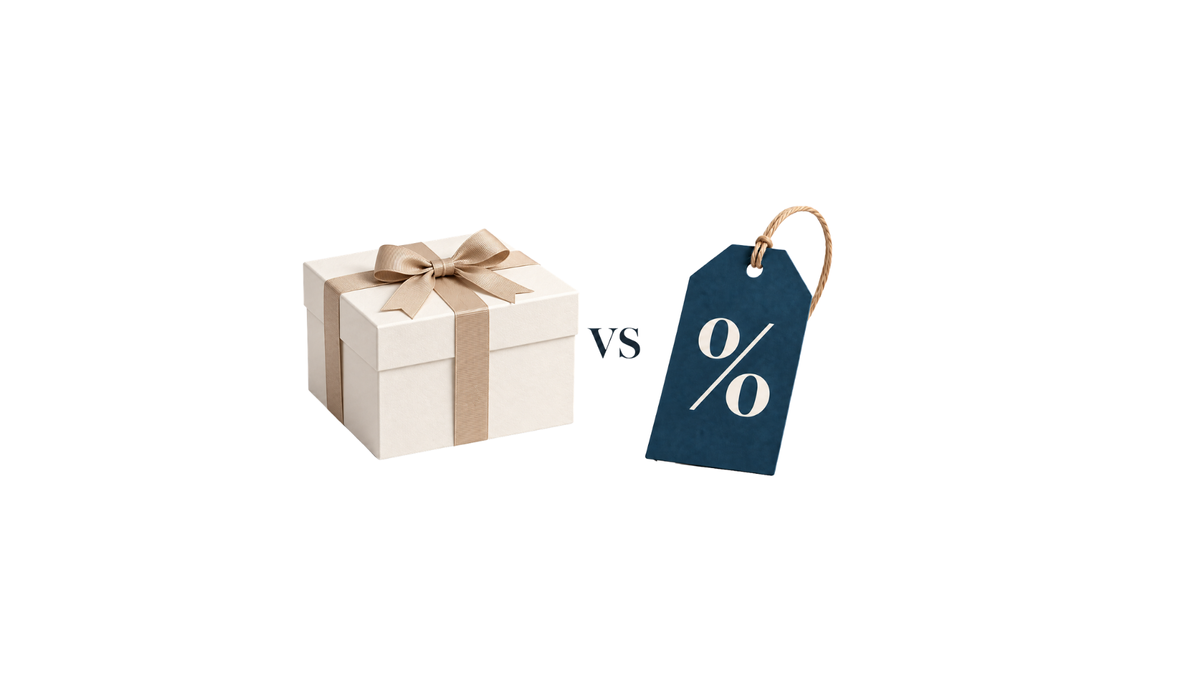
Choosing Between Free Product and Discount: The Two Decisions That Shape Reward Economics
Most loyalty programs fail on two questions that get decided by accident: how much to give, and when to give it.
The first decision is timing and size small frequent rewards versus larger delayed rewards. A free coffee on the fifth visit lands quickly and keeps people coming back; a €25 credit after twelve visits is worth more but asks for patience.
Research summarized by Access Development points to why that matters: 42% of consumers say it takes too long to earn a reward, and 71% dislike complicated redemption. The average shopper is signed up for roughly 17.9 programs and active in about half.
The second decision is reward type a free product versus a percentage discount. Both cost you money, but they cost it differently. A discount comes straight out of margin on a sale you were probably making anyway. A free item costs you the wholesale price, not the retail price, and it gives the customer something to hold.
These two choices are the whole of loyalty program design and economics for a small business. Reward type, timing, and margin have to be decided together, using three inputs covered later: basket size, repeat rate, and margin.
When Small Frequent Rewards Work Better Than Larger Delayed Ones
Reward timing is a business decision, not a taste question. A 2006 Journal of Retailing study found that satisfied customers lean toward delayed, direct rewards of higher value, while dissatisfied customers prefer immediate, direct ones. In practice: if people already like you, they will wait for something worth waiting for. If they are lukewarm, make the payoff fast or they stop counting.
That maps cleanly onto visit frequency. A coffee shop sees the same face four times a week, so the tenth-cup free reward lands before interest fades. A hair salon with a six-week cycle needs a reward the customer can still remember usually a free add-on service after three or four visits, not a slow points balance. Access Development's research on redemption speed reports that 42% of consumers feel it takes too long to earn a reward and 71% dislike complicated redemption, which is the main risk of stretching the earn period too far.
Margin decides the reward type. A free product feels tangible and costs you wholesale, not retail strong for high-frequency, low-ticket categories. A percentage discount scales with basket size, which suits higher-ticket services where a fixed free item would be either trivial or expensive.
| Business | Visit frequency | Margin profile | Reward that usually fits |
|---|---|---|---|
| Coffee shop | Several times weekly | High margin, low ticket | Free drink after 8–10 visits |
| Hair salon | Every 4–8 weeks | Mid margin, mid ticket | Free add-on service after 3–4 visits |
| Quick-service retail | Weekly | Thin margin, low ticket | Small free item, low earn threshold |
| Higher-ticket services | A few times a year | Variable margin, high ticket | Percentage off a future booking, or a delayed credit |
The tradeoff is plain: immediate rewards get used more often and cost you more often; delayed rewards protect margin, but only if customers stay engaged long enough to claim them.
How Basket Size, Repeat Rate, and Margin Point to the Right Reward
Most loyalty program design and economics questions come down to three numbers you already have on your receipts. Work through them in order.
Step 1: Basket size
Under roughly €10–15 a visit, a percentage discount is too small to notice. Give a free item instead: the coffee, the wash, the topping. Above that, a percentage off the whole basket starts to feel meaningful but only move forward if step 3 clears.
Step 2: Repeat rate
Weekly or daily visits reward speed. Short earn cycles beat big prizes here, and Access Development's research on quick redemption reports that 42% of consumers feel it takes too long to earn a reward and 71% dislike complicated redemption. Slower cycles a salon every six weeks, a garage twice a year — need stronger perceived value to stay top of mind. A 2006 Journal of Retailing study found satisfied customers actually prefer delayed, higher-value rewards, so a bigger payoff is defensible when visits are spaced out.
Step 3: Margin
A percentage discount scales with the basket, so it grows when you least want it to. A free product caps your exposure at one known cost. If your margin is thin or variable, choose the capped item. If it's healthy and predictable, the discount is fine and a 2022 Journal of Retailing study found coupon-style offers generated three times the incremental revenue of loyalty point rewards in the case it examined, so price-based incentives are not automatically the weaker choice.
Step 4: The counter check
Whatever you pick, staff must apply it in one scan. Scannable digital passes make this workable: one tap records the visit, one tap marks the reward claimed.
The short rule set:
small basket, frequent visits → fast free item.
Large basket, strong margin → percentage discount.
Thin margin → capped free product.
Slow cycle → fewer, bigger rewards.
Anything your counter staff can't explain in a sentence → simplify it.
Free Product vs Percentage Discount: What Changes in Perceived Value, Speed, Cost Control, and Motivation
Both rewards can cost you the same on paper and behave completely differently at the counter. A free coffee at a fixed cost of goods is predictable; 20% off a large basket is not. That gap is where most loyalty program design and economics decisions are actually won or lost.
| Criterion | Free product | Percentage discount |
|---|---|---|
| Perceived value | Feels concrete customers can picture the item they're getting | Abstract until the total is calculated; value varies by basket |
| Redemption speed | Fast at the point of sale: scan the pass, hand over the item | Fast too, but the amount depends on what's in the cart |
| Cost control | Capped at your cost of goods per redemption | Uncapped unless you set a maximum discount |
| Customer motivation | Builds the habit of returning for a specific item | Encourages a bigger basket on the visit it's used |
Percentage discounts and free products serve different purposes. Discounts can encourage customers to spend more during a visit. Free products make the reward feel tangible and give customers a clear reason to return.
For retail and service businesses, percentage discounts are easy to explain at checkout. Free products make budgeting easier because the cost of each reward is known in advance. Choose based on your margin per item and how often your customers come back.
Make Rewards Easy to Earn and Use
A reward gives customers a reason to return, but the process needs to be clear. Customers should know what they’ll receive, how close they are to earning it, and how to claim it.
Keep the rules simple enough for staff to explain in one sentence: “Visit five times and your next coffee is free.” At checkout, recording a visit or claiming a reward should be quick and straightforward. A digital loyalty pass in Apple Wallet or Google Wallet lets customers keep their card on their phone and present it for scanning when they pay.
Choose a reward that fits your margins and your customers’ visit frequency, then make it easy to track and redeem. A clear offer and a smooth checkout experience make the program easier for customers to use and staff to manage.
FAQ: Choosing the Right Reward for Your Business
When should I offer a free product?
A free product works well when customers visit regularly and you can offer something they value at a manageable cost. A coffee, a side dish, or a simple add-on service gives customers a clear reward to work toward. It also makes budgeting easier because you know the cost of each item you give away.
When should I offer a percentage discount?
A percentage discount can suit higher-value purchases or appointments that include several services. Its value reflects how much the customer spends, making it meaningful across different basket sizes. Set clear limits, such as a maximum discount amount, to keep the cost manageable.
How should my profit margin influence the choice?
Calculate what each reward will cost you before choosing. For a free product, include the cost of providing it. For a discount, check how much profit remains after the reduction. If your margins are tight, a low-cost product or a capped discount can help you keep the offer sustainable.
How do I get started?
Choose one reward and a clear earning rule, such as “Buy five coffees, get one free.” With Loyaltify, customers can keep a digital loyalty pass in Apple Wallet or Google Wallet and scan it when they visit. Track how often customers return and redeem their rewards, then use that data to adjust your offer.
Ready to give your customers a reason to come back?
With Loyaltify, you can create a digital loyalty program with rewards that are easy to earn and simple to redeem.
Turn everyday visits into lasting customer relationships.
Get started with Loyaltify today.