
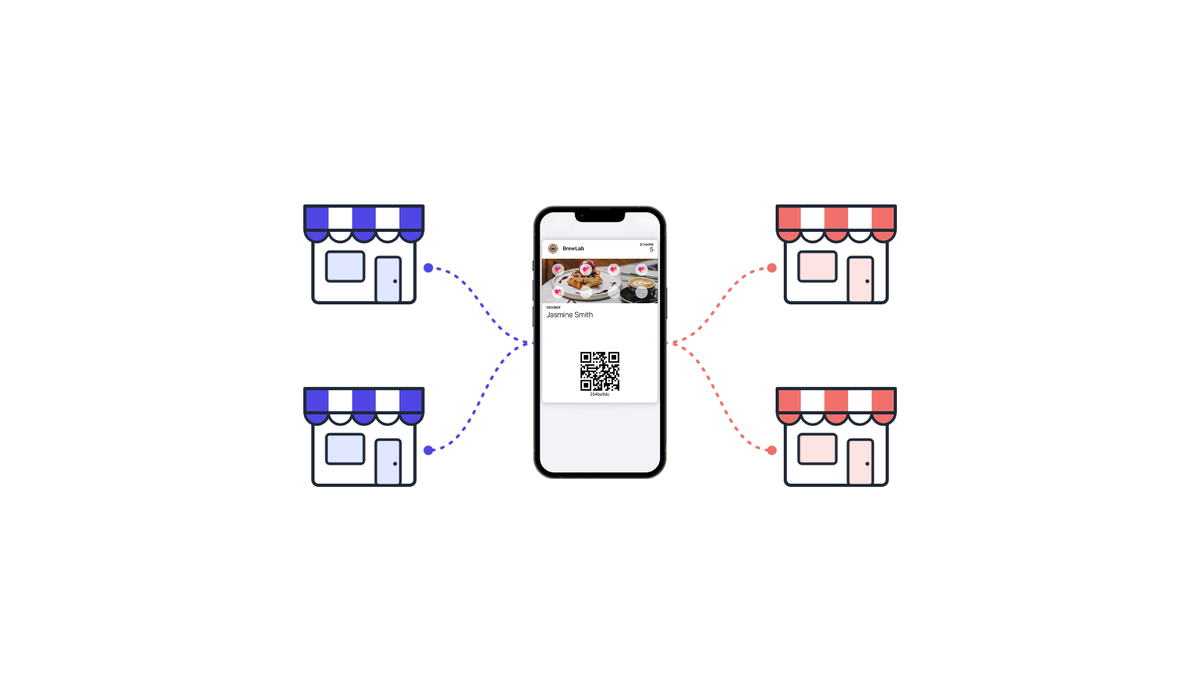
If you have more than one branch or more than one brand, settling your loyalty program before you grow makes your life much easier. There are four core decisions in front of you. First, whether branches will share a single reward or each will run its own program. Second, if you have multiple brands, how to separate them from one another. Third, how to structure the pilot you'll run at a single branch. Fourth, what precautions to take against problems like fake stamps, duplicate cards, and unauthorized rewards.
If you clarify these four decisions in advance, you won't need to redesign the program every time you open a new branch. Loyaltify offers a practical tool that makes implementing each of these decisions easy, because it runs cards as tap-to-scan cards that work in Apple Wallet and Google Wallet, instead of printed cards or a separate app.
In this article we address the four decisions in order, because each builds on the one before it. Your reward structure determines how you'll separate your brands, and the two together shape what you'll measure in the pilot. The pilot, in turn, shows which fraud-prevention measure should take priority at your counter.
Should branches share a single reward,
run separately, or use a shared core
reward + local campaigns
If your branches sell similar products at similar prices and customers move between them, sharing a single reward makes sense. If branches differ in products, prices, or customer profile, localizing is the more appropriate choice. For most growing businesses, the best answer sits in between: a shared core reward valid everywhere, plus a few local campaigns each branch controls on its own.
The determining question is this: would the customer reasonably expect their progress to follow them? Someone who buys coffee from your branch near their workplace on weekdays and near their home on weekends expects a single card. If they have to start from zero at every branch, they'll feel cheated. A bakery and a restaurant run by the same owner, on the other hand, serve different kinds of visits and different price points. Forcing the same stamp card on both makes the reward too generous on one side and inadequate on the other.
| Structure | Best fit | Customer experience | Management burden | Fraud risk |
|---|---|---|---|---|
| Shared core reward + local campaigns | Similar core menu, some local differences | One card everywhere, extra perks at some branches | Moderate: one core rule, a few local rules | Moderate: local campaigns need their own limits |
| Single shared program | Same menu, same prices, customers visit multiple branches | One card, progress valid everywhere | Low: a single rule set | Higher: one weak point affects the whole program |
| Branch-specific programs | Offer, price, or customer profile differs across branches | Separate card per branch | High: separate rules and reporting per branch | More contained spread: issues stay within one branch |
The table actually points to a clear conclusion. The hybrid structure keeps the promise to the customer simple while leaving each branch manager room to act on local demand. A single shared program is the easiest to manage, but it ties every branch's stamping discipline to the same ledger. Separate programs contain problems, but they fragment the customer relationship.
Card format is the second half of this decision. If you're sharing the reward, every branch should use the same card, so the customer never has to wonder which card to show. If you're localizing, separate cards make the difference visible at a glance. Because Loyaltify programs are configurable digital cards, you can use a single card across all branches or a separate card for each program. Changing your mind later doesn't mean reprinting cards, either. To adapt the format to your business, you can check out the guide on choosing the right loyalty card type.
How to separate a loyalty program if you have multiple brands
The branch decision assumes a single brand; owning two brands raises a different question. The answer is to give each brand its own card and its own identity, then make a clear decision about how much the two programs will share. A customer who loves your pizzeria may not even know you also run the juice shop on the same street. Unless you want them to, they shouldn't find that out through a confusing loyalty card.
Separate branding protects the value each business has built. Because Loyaltify operates white-label, the cards display your business's own logo and colors rather than the platform's. This way, your two businesses genuinely look like two separate businesses, and a shared platform logo doesn't blur the line between them.
Once the cards are separated, running a loyalty program across multiple brands requires choosing one of three clear policies:
- Fully separate
Customer data, stamps, and reward usage stay within each brand. Choose this option if your brands serve different audiences or if you're considering selling one of them in the future. - Shared data, no cross-use
You can see that the same customers visit both brands, but a reward earned at one brand can't be redeemed at the other. This is the right choice if you want visibility without linking the two businesses' cost structures. - Time-limited cross-brand campaign
A stamp earned at one brand counts toward a reward at the other. Run this as a temporary promotion with a start date, end date, and budget don't turn it into a permanent rule.
The trap is drifting into the third option without noticing. For example, a branch manager accepts a juice-shop stamp at the pizzeria register "just this once." Before long, customers start expecting it, and your margin carries the load. That's why the policy needs to be written down and both teams need to be informed about it.
Margin structure also shapes the reward itself. A brand selling low-margin, high-volume products may be better suited to a visit-based stamp card. A brand with healthier margins and a higher average ticket may work better with a percentage discount. The points vs discounts comparison can help you choose which mechanism fits the budget for each brand. You don't have to use the same reward type for both brands; what matters is that each one's logic is consistent.
How to run a pilot at a single branch
Once the structure is settled, next comes testing it. Run the pilot at a branch specific to you, with a fixed duration and a fixed reward threshold. Set your go/no-go criteria and your scorecard before day one. Choose a branch with typical traffic and a typical team. Stay away from both your best-performing and your most troubled branch, so the results genuinely reflect what will happen at your other branches.
Fix the reward threshold before launch and don't touch it during the pilot; changing it midway makes all the prior data incomparable. If you're not sure where to set the threshold, the how often should you reward customers guide gives you a defensible starting point.
The most important metric isn't sign-up count but active member count, because being interested and actually using the program aren't the same thing. According to a 2026 consumer survey, 86% of consumers said loyalty rewards matter to them, while only 38% said they regularly use restaurant programs. So a pilot that boasts a large sign-up number may actually be hiding a program that people barely use after the first week.
Incremental spend is the second test. Deloitte's 2025 Consumer Loyalty Program Survey found that 56% of members increased their spending because of a loyalty program. However, treat that as a reference point, not a guarantee. If your members' spending looks no different from non-members', the reward is not pulling its weight.
Both metrics take time to become visible, which is why pilot duration matters. There's no universal benchmark for pilot length; set the duration based on your own repeat-visit cycle. Keep it long enough for regular customers to complete two or three full earn-redeem cycles. A café with daily regulars reaches that point much faster than a beauty salon does.
| Metric | How it's measured | Example decision threshold (you set it) |
|---|---|---|
| Active members | Members who earn at least once after signing up | A large majority of members return to earn again |
| Sign-up rate | Cards created / eligible transactions | Steady weekly sign-ups, not just a launch spike |
| Repeat visit rate | Visits per active member during the pilot | Higher than your pre-pilot estimate of regulars |
| Rewards redeemed | Rewards claimed / rewards earned | Customers actually redeem, not just accumulate |
| Staff stamping consistency | Stamps per eligible transaction by shift | Similar rates across shifts and staff |
| Flagged anomalies | Unusual stamp spikes or repeated redemptions | Few in number, and each one explainable |
A "go" decision means hitting most of the thresholds you set in advance. A single "no" on one line usually doesn't mean canceling the program it means fixing it and trying again. For example, a low redemption rate usually signals the threshold is set too high, while uneven stamping points to a training need.
Precautions against fake stamps, duplicate cards, and unauthorized rewards
The anomalies row in the scorecard leads you straight into fraud prevention. You reduce the risk of fake stamps and unauthorized rewards by limiting who can add stamps and approve rewards, setting usage caps, blocking duplicate cards, and reviewing activity per person. There's no reliable data on how much loyalty program abuse comes from staff versus from customers, so treat both as possibilities and build controls that cover each.
The core foundation is logged scanning. In Loyaltify, cards are recorded through scanning rather than stamped on paper, so every stamp and every redemption is tied to a member and a transaction. This log is what makes the checklist below actionable. A paper card stamped with ink leaves nothing behind to review.
Run the following checks at every branch:
- Staff permissions Decide who can add stamps and who can approve rewards. Most businesses let all register staff add stamps but reserve reward approval for a shift lead or manager. Give each person a separate login rather than a shared register password, so activity can be traced back to an individual.
- Per-visit and per-day limits Cap stamps at one per eligible purchase and set a reasonable daily ceiling per customer. A customer earning five stamps in one hour is either a large group order or a problem; a limit forces that question to be asked.
- Redemption rules Limit redemption to one reward per visit, and require that reward redemption be verified by scanning the card rather than by name. "I'm a member, I swear" should never be enough to hand out a free item.
- Duplicate cards Monitor whether the same phone number or email has more than one card behind it, and watch for new cards used at an unusually fast pace. Merge or close duplicates, and note the reason.
- Screenshot use Since a static image of a card can circulate among friends, scan the live card in the customer's wallet instead of accepting a photo. Also flag cards showing the same activity at two branches at once.
- Per-person and per-branch review Compare stamp and redemption rates by person and by shift every week. If an employee is issuing noticeably more stamps per transaction, talk to them; the cause is usually a training gap, not theft.
Staff permissions and training must be ready before opening day as you roll out branch by branch
Once the pilot is approved and your fraud-prevention measures are written down, open branches one at a time rather than all at once. Before opening each new branch, run a pre-check against the list of common mistakes in loyalty programs. Skip this once, and unclear rules and overly generous rewards will keep recurring at every new register.
Since opening-day rush won't leave you time for setup, prepare staff logins and permissions before opening day. Every new employee needs to know three things. They should know who adds stamps, who approves rewards, and what the limits are. They should also know how to scan a live card and how to spot a screenshot. Finally, they should know what to tell a customer whose stamps appear to be missing. A short briefing covering these three points works far better than a long manual no one reads.
Then benchmark every new branch against the pilot scorecard throughout its first full earn-redeem cycle. This is exactly where multi-branch staff and customer management adds value. If one branch's stamping rate or redemption pattern diverges from the others, you catch it early and fix it on the spot. Without a reference point, that deviation spreads through your whole program unnoticed.
Adding a new branch isn't about printing and shipping a card it's about making the same card valid at that branch and adding staff. Done this way, a careful, slow-paced opening process costs you almost no time at all.
Frequently Asked Questions
How do you get staff to use the program consistently without slowing down checkout?
Keep the loyalty step limited to a single scan of the card in the customer's wallet, so it adds almost nothing to the transaction. Give each employee a separate login with clear permissions, and train them on stamping and redemption rules before their first shift. If one person's stamping rate lags behind their colleagues', that usually points to a training gap you can close with a short conversation.
Can a customer earn at one branch and redeem at another?
Yes, if you're running a shared program or a shared core reward. Since customers carry a single wallet card, their progress travels with them to every branch. If your branches run separate programs, redemption is local by design. Whichever you choose, state the rule clearly on the card and inform staff, so no register makes its own call.
Do customers need to download an app to use it at every branch?
No. With Loyaltify, the loyalty card is a card saved to Apple Wallet or Google Wallet, already on customers' phones. They add it once, then show the same card at every participating branch. There's nothing to install and no physical card to lose.
How often should you review cross-branch activity?
Review activity weekly by branch and by staff member during each new branch's first earn cycle, then move to monthly checks once the numbers settle. Look at active member count, rewards redeemed, and stamps per transaction. If any branch or employee shows a pattern noticeably different from the others, investigate before the gap grows.