
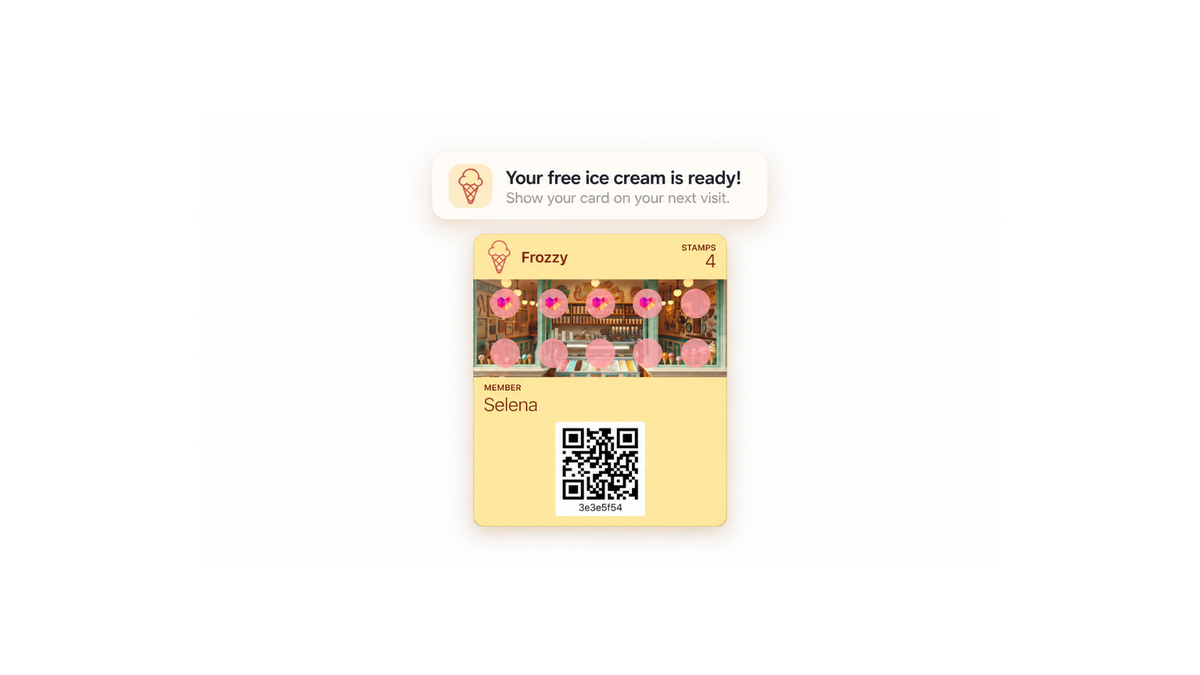
A loyalty message has one main purpose: to give customers a meaningful reason to visit again. That reason might be a free coffee, an almost-completed stamp card, or a reward waiting to be redeemed. Its effectiveness depends less on how creative it sounds and more on how relevant it is to the customer’s situation.
Generic phrases like “Discover our latest offers” do not explain why someone should act. “You’re two visits away from a free coffee” shows progress and gives the customer an achievable goal. They immediately understand why the message matters to them.
The stakes are real: 85% of loyalty program members say the program makes them more likely to keep doing business with a brand, according to Bond Brand Loyalty's 2025 report. The same report found that "makes me feel valued" is the single biggest driver of loyalty across 360+ programs ahead of discounts or points. Messages are one of the clearest ways to deliver that feeling, or to undermine it.
For small businesses, an effective communication plan does not need to be complicated. A few well-chosen messages, sensible timing, and a simple way to review results are enough to get started. This guide explains which messages to use in your digital loyalty programme, when to send them, and how to improve them based on results.
Give Customers a Concrete Reason to Act
Customers receive plenty of notifications throughout the day. To stand out, your loyalty message needs to be clear, short, and relevant. The easiest way to achieve this is to connect it to something the customer actually did or earned.
A visit, a purchase, a new stamp, or an unlocked reward creates a natural opportunity to communicate. The message becomes useful information about their progress rather than an advertisement sent at random.
When writing, answer three questions: What happened? What does it mean for the customer? What can they do next? You do not need a lengthy explanation. One or two short sentences will usually do.
For example, “Your balance has been updated” provides information but leaves out the benefit. “Your fourth stamp has been added. Earn your free coffee on your next visit” shows both progress and the next step.
Four Key Moments for Loyalty Messages
Instead of sending everyone the same message, communicate according to where customers are in your programme. Someone who has just joined needs different information from someone who has already earned a reward.
These four moments can form the foundation of a simple, manageable messaging plan:
| Loyalty moment | Message purpose | Example message |
|---|---|---|
| Joining the programme | Explain the first step | “Welcome! Scan your card on every visit, and your fifth coffee is on us.” |
| Approaching a reward | Make progress visible | “Three stamps collected! You’re just two visits away from a free coffee.” |
| Earning a reward | Make redemption easy | “Your free coffee is ready! Show your card at the counter on your next visit.” |
| Visiting less often | Give a reason to return | “Your stamps are waiting on your card. Pick up where you left off on your next visit.” |
1. Show New Members How to Get Started
Your welcome message is the customer’s first interaction with the programme. The aim is to make getting started easy, rather than explain every rule. Thank them briefly, then explain how to use their card and earn a reward.
“Welcome aboard! Show your digital card with every purchase to get one step closer to your reward.”
If your programme has straightforward rules, be more specific: “Buy five coffees and get your sixth free.” Customers should understand what they can earn and how to earn it in a single read.
Including several promotions, social media links, and different calls to action can distract from that first step. Focus on getting the card used. Introduce other benefits when they become relevant.
2. Show Progress to Encourage the Next Visit
A loyalty programme becomes more valuable when customers can see their progress. Stamps and points mean more when they connect to an achievable reward.
Instead of saying “You have 120 points,” try “A free dessert is yours at 150 points. Just 30 more to go,” provided that reflects your programme’s actual rules. Customers should not have to work out the benefit themselves.
You do not need to send a notification for every small update. Routine changes can appear on the digital card. Saving messages for meaningful milestones helps keep communication useful.
The goal should also feel realistic. If customers still need many visits to earn a reward, repeated countdowns can lose their impact. A reminder sent when the reward is within reach gives them a stronger reason to return.
3. Make Earned Rewards Easy to Redeem
When customers earn a reward, they need to know it is available and understand how to use it. A good reward message names the benefit and makes the redemption step clear.
“Your free dessert is ready! Just show your digital card to our team on your next visit.”
If the reward applies only to certain products or comes with conditions, clearly communicate anything that affects the customer’s decision. The message can stay short, with further details available on the card or in the relevant description.
Include an expiry date when there is a real one. “Your reward is valid until Sunday” helps customers plan their visit. If there is no deadline, avoid using “last chance” simply to create urgency.
The in-store experience should match the message. When customers show their card, your team should know which reward applies and how to complete the redemption.
4. Remind Customers Who Have Not Visited Recently
Customers’ routines change. A gap between visits does not necessarily mean they are unhappy with your business. Sometimes, a reminder of their existing stamps or rewards is enough.
Before offering a new discount, remind them of the value they already have:
“Your four stamps are still on your card! Keep working towards your free coffee on your next visit.”
Keep the tone friendly without making customers feel they owe you an explanation. Instead of “Where have you been?” or “Have you forgotten us?”, show the benefit of returning.
If the first reminder does not work, avoid repeating it a few days later. Wait according to the customer’s usual visit pattern. If you introduce an offer, make sure it is sustainable for your business and easy for the customer to understand.
Match Message Frequency to Visit Patterns
There is no single sending schedule that works for every business. A café customers visit several times a week should communicate differently from a salon they book every two months.
Start with how often customers normally visit. Then consider how long it realistically takes to earn a reward. Messages feel more natural when they follow those rhythms.
Use the following table as a starting point and adapt it to your program:
| Customer status | When to communicate | Suggested approach |
|---|---|---|
| Just joined | After registration | Send one welcome message explaining how to use the card. |
| Has not used the card | After a reasonable window for a first visit | Send one reminder explaining how to earn stamps or points. |
| Visits regularly | When they reach a meaningful reward milestone | Share their progress or newly earned reward. |
| Visits less often | When they exceed their usual visit interval | Remind them of their existing balance or reward. |
| Has not visited for a long time | After several usual visit intervals have passed | Send one return message, then review the results. |
For a general benchmark, ADIM Media notes that service businesses generally do well with about 1–2 messages a month, while retail and e-commerce businesses can sustain about 1–2 messages a week, following roughly an 80/20 split of useful, value-driven content versus pure promotions. Treat these as a starting range rather than a fixed rule, and adjust based on your own results, according to ADIM Media.
Avoid applying the same schedule automatically to everyone. Some customers naturally visit less often. Base your decisions on individual visit history whenever possible.
Also consider all messages sent during the same week. A welcome message, reward notification, and general promotion may serve different purposes, but customers experience them all as communication from the same business.
Adjust the Message to Your Business Type
The subject of your message matters as much as its frequency. Thinking about why customers visit your business helps you create more relevant reminders.
| Business type | Useful message focus | Messaging approach |
|---|---|---|
| Café | Collected stamps and nearby rewards | Short progress reminders that are easy to understand |
| Restaurant | Earned treats or visit benefits | Clear messages explaining the reward and how to use it |
| Hair or beauty salon | Rewards available at the next appointment | Reminders aligned with the customer’s booking pattern |
| Retail shop | Points balances and available benefits | Messages explaining what points can provide on a purchase |
Use these examples to choose a focus rather than as strict rules. Different customer groups within the same business may need different reminders.
Separate Useful Updates from Promotional Messages
Telling customers their reward is ready is different from announcing a new promotion. The first concerns something they have already earned. The second asks them to make another purchase or visit.
Keep that distinction in your sending plan. Information about earned rewards and genuine expiry dates can directly help customers make decisions. Be more selective with promotional messages.
Before sending a campaign, ask: “What does this give the customer that the previous message did not?” If the only answer is that your business wants more sales that day, reconsider the message.
Repeatedly announcing the same reward in different words does not create new value. Communicate when the customer’s situation changes or when the offer is genuinely different.
Use Short, Clear, Natural Language
Loyalty messages should be quick to understand. Put the main information first: Is a reward ready? How many stamps remain? What should the customer do?
Avoid lengthy introductions and vague phrases such as “Discover incredible, unmissable offers.” A specific reward usually says more than decorative language.
| Generic wording | Clearer alternative |
|---|---|
| “We value your loyalty.” | “Your fifth visit is complete. Your free coffee is ready!” |
| “Explore your benefits.” | “You have a free dessert available on your card.” |
| “We look forward to seeing you again.” | “One stamp to go! Complete your reward on your next visit.” |
| “Don’t miss out!” | “You can use your earned reward until Sunday.” |
Using a first name can help, but accurate information makes the biggest difference. The correct balance, a relevant reward, and suitable timing make a message feel personal.
Read the message on a phone before sending it. If the main point is not immediately clear, shorten it. Leave customers with one clear next step.
Recognise the Signs of Message Fatigue
Customers will not always tell you when you communicate too often. Instead, engagement may fall, fewer rewards may be redeemed, or more digital cards may be removed.
One weak result does not automatically mean message fatigue. Offer relevance, timing, and seasonal changes can also affect performance. Look for patterns across several sends.
If message volume increases while returns stay flat, try reducing promotional frequency first. Keep useful updates, such as available reward notifications, while simplifying the overall plan.
Remove outdated reminders too. If customers keep receiving messages about rewards they have already redeemed, trust can suffer. Messages should reflect current customer information.
Use Notifications and Reporting to Improve Results
Message views are a useful starting point, but the real goals are repeat visits and reward redemptions. Avoid judging performance by open rates alone.
Depending on the data your system provides, track the following indicators:
| Metric | What it tells you | How to use it |
|---|---|---|
| Views or opens | Whether customers noticed the message | Review timing and the opening sentence. |
| Reward redemptions | Whether customers used the benefit | Check reward clarity and ease of redemption. |
| Repeat visits | Whether customers returned after the send | Compare results across message types. |
| Notification opt-outs or card removals | Whether customers are disengaging | Review frequency and relevance. |
Do not assume every visit following a message happened because of it. Compare similar customer groups and similar periods for a more useful assessment.
Break the numbers down by message type and customer segment — new joiners, active customers, lapsed customers — instead of looking at one blended average. This shows which reminders actually lead to rewards claimed and which ones are mostly ignored.
Use what you find to make specific decisions: pause a message type with weak redemptions, tighten the timing window on a reminder that arrives too early or too late, or leave a message alone when the numbers hold up. A short monthly review is enough to catch these patterns. Adjust one element at a time so you can tell what actually moved the results.
Frequently Asked Questions
How long should a loyalty message be?
Shorter is almost always better. One or two sentences are enough to say what happened, what it means, and what to do next. If a message needs several lines to make its point, it usually needs a clearer point, not more words.
Should I notify customers about every reward?
No. Send a notification for meaningful milestones — a reward earned, a reward about to expire, a long gap since the last visit. Routine updates, like a small change in points balance, can stay on the digital card itself. Notifying for every small change is one of the fastest ways to create fatigue.
How do I make loyalty messages feel personal?
A first name helps, but accuracy matters more. A message that shows the correct balance, the right reward, and good timing feels personal even without a name. A message with a name but the wrong stamp count or an expired offer feels careless.
Do promotional and transactional loyalty messages need different timing?
Yes. Messages tied to something a customer already earned a reward ready, an expiry date can go out as soon as they are true, since they help the customer act. Promotional messages asking for another visit or purchase should go out less often and only when the offer adds real value.
The rule to keep in mind across all of this: send a message when it helps the customer act, not just when the business wants attention. Use your reporting to check that the rule is working, and adjust cadence or wording from there rather than guessing.
Start the Next Visit with Loyaltify
An effective loyalty programme makes earned value visible. A good message reminds customers of that value at the right moment. Sometimes, a free coffee or an almost-completed card is enough to give them a reason to return.
You do not need complicated campaigns to begin. Choose a clear reward, show customers how to earn it, and connect your communication to their actual progress.
Try Loyaltify for free. Give customers a reason to join today and come back tomorrow.